
Insights
How to Measure Digital Transformation ROI Without Making Up the Numbers
Tom Holt ·
- Measurement
- ROI
- Digital Transformation

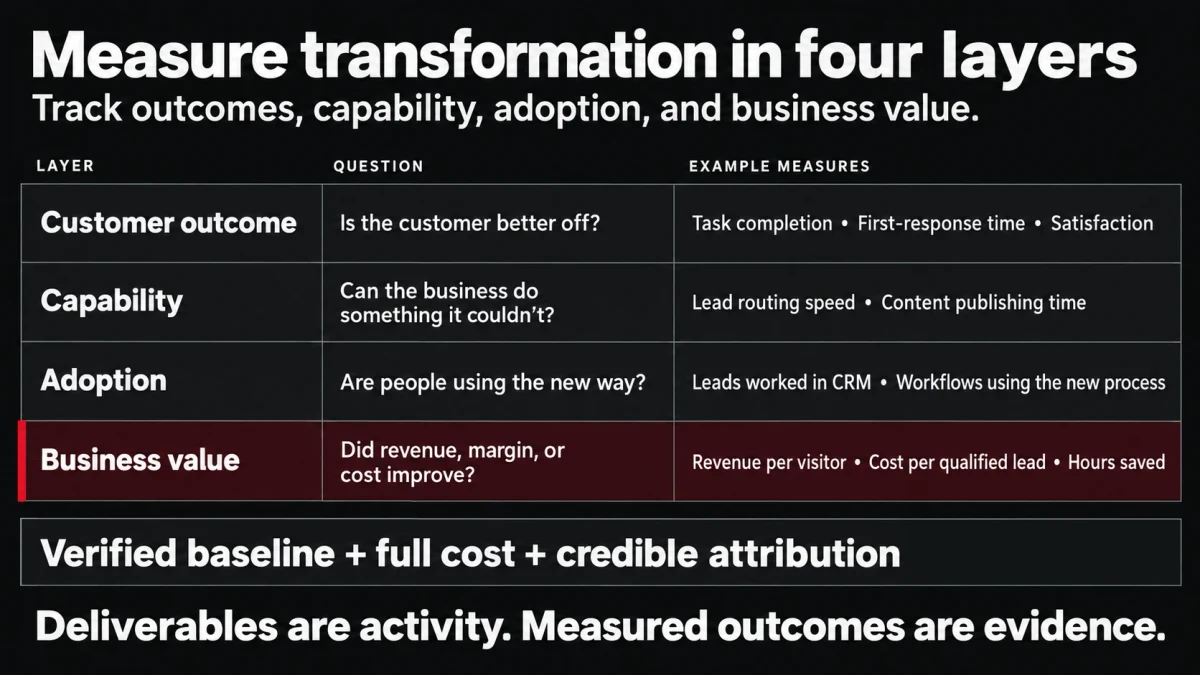
Short answer: To measure digital transformation ROI, capture a verified baseline before you change anything, then track results in four layers: customer outcome, capability, adoption, and business value. Attribute only the change you can trace to the initiative. Count deliverables as activity, not proof.
Why ROI conversations go sideways
The usual failure is timing. A project launches, someone asks “what did we get?”, and there is no pre-change number to compare to. The team reaches for proxies: page views, logins, features shipped. Leadership hears activity and concludes nothing improved, or the team claims credit for a trend that was already underway.
Both outcomes are avoidable. The fix is boring and works: write the baseline and target before you build.
Step 1: Choose the outcome, not the output
Outputs are things you produce: a new site, a new CRM, 40 articles. Outcomes are changes in the business: more qualified appointments, shorter quote cycles, higher repeat service revenue.
Start with one primary outcome per initiative, and no more than two supporting measures. If you can’t connect a metric to revenue, margin, retention, or operating cost within two steps, it’s probably a vanity metric.
Step 2: Use four layers of measurement
| Layer | Question | Example metrics |
|---|---|---|
| Customer outcome | Is the person we serve better off? | Task completion rate, first-response time, repeat contacts, satisfaction |
| Capability | Can the business now do something it couldn’t? | Lead assigned within 5 minutes, content published in 2 days instead of 3 weeks |
| Adoption | Are people actually using the new way? | % of leads worked in the CRM, % of workflows run through the new process |
| Business value | Did money or margin move? | Revenue per visitor, cost per qualified lead, conversion rate, hours saved |
A project can look fine in one layer and fail in another. Strong capability with weak adoption means the change never took hold. Strong adoption with no business value means you built the wrong thing.
Step 3: Capture the baseline honestly
- Pull at least 8 to 12 weeks of pre-change data, or a full seasonal cycle for seasonal businesses such as RV, marine, and powersports.
- Name who verified the number and where it came from.
- Note known data problems (duplicate leads, missing source fields). Don’t hide them. A baseline you can defend beats a baseline that looks impressive.
- Record what else is changing (promotions, pricing, market conditions) so you can separate your effect from background movement.
Step 4: Be explicit about attribution
For channel-level questions, multi-touch attribution is useful but imperfect. For transformation-level questions, simpler tools often work better:
- Before and after with a control, such as one region or product line that changes first.
- Phased rollout, comparing adopters with non-adopters.
- Operational timing studies, such as measuring minutes per task before and after.
State your confidence. “Lead response time dropped from 6 hours to 11 minutes” is a direct measurement. “Revenue rose 4% because of the new site” is an inference unless you can isolate the cause.
Step 5: Count the full cost
ROI needs a denominator. Include licenses, implementation, internal time, training, and the ongoing cost to maintain. Add the cost of the old way you retire, and the cost of delay if you do nothing. Marketing budgets are flat at 7.7% of company revenue, according to Gartner’s 2025 CMO Spend Survey, and 59% of CMOs say they lack the budget to execute their strategy. Efficiency gains are often the fastest route to fund the next initiative.
A simple ROI statement that holds up
Between [date] and [date], [outcome metric] moved from [baseline] to [result]. At [adoption level], this represents [business value]. Total cost was [amount]. We are [high / medium / low] confident in the attribution because [method].
If you can’t fill that in, you’re reporting activity.
Reporting cadence
- Monthly: adoption and capability metrics. They move first.
- Quarterly: customer outcome and business value.
- Annually: strategic impact, such as share, retention, and cost structure.
Use measurement as a feedback loop. When a metric stalls, ask what friction remains rather than adding more reporting.
Next step
Choose one live initiative and fill in the ROI statement above with today’s numbers. Wherever there’s a blank, that’s your measurement gap. Rogue’s Data & Analytics Strategy work builds the baseline and reporting model so the next review is a conversation about decisions, including attribution across dealer networks. Start a Transformation Assessment.
Sources
- Gartner, 2025 CMO Spend Survey (May 12, 2025; 402 marketing leaders, fieldwork February to March 2025).
- Rogue Digital Group, measurement standards (four-layer model).
See also: Why Digital Transformation Programs Fail
Frequently asked questions
- How do you calculate ROI on digital transformation?
- Compare the measured change in a business outcome against the full cost of the initiative, using a pre-change baseline. Report the confidence level of your attribution, not just the percentage.
- What metrics should I track?
- Use four layers: customer outcome, capability, adoption, and business value. Pick one primary outcome and at most two supporting metrics per initiative.
- How long before results show up?
- Adoption and capability metrics can move within 30 to 90 days. Revenue and retention effects usually take one to three quarters, longer in seasonal businesses.
- What if I don't have a baseline?
- Reconstruct one from existing systems for the last 8 to 12 weeks and document its limits. If that isn't possible, measure from today and be clear that earlier performance is unknown.